Desert Camping in the UAE: Ten Ways to Spend a Night in the Dunes (2026)
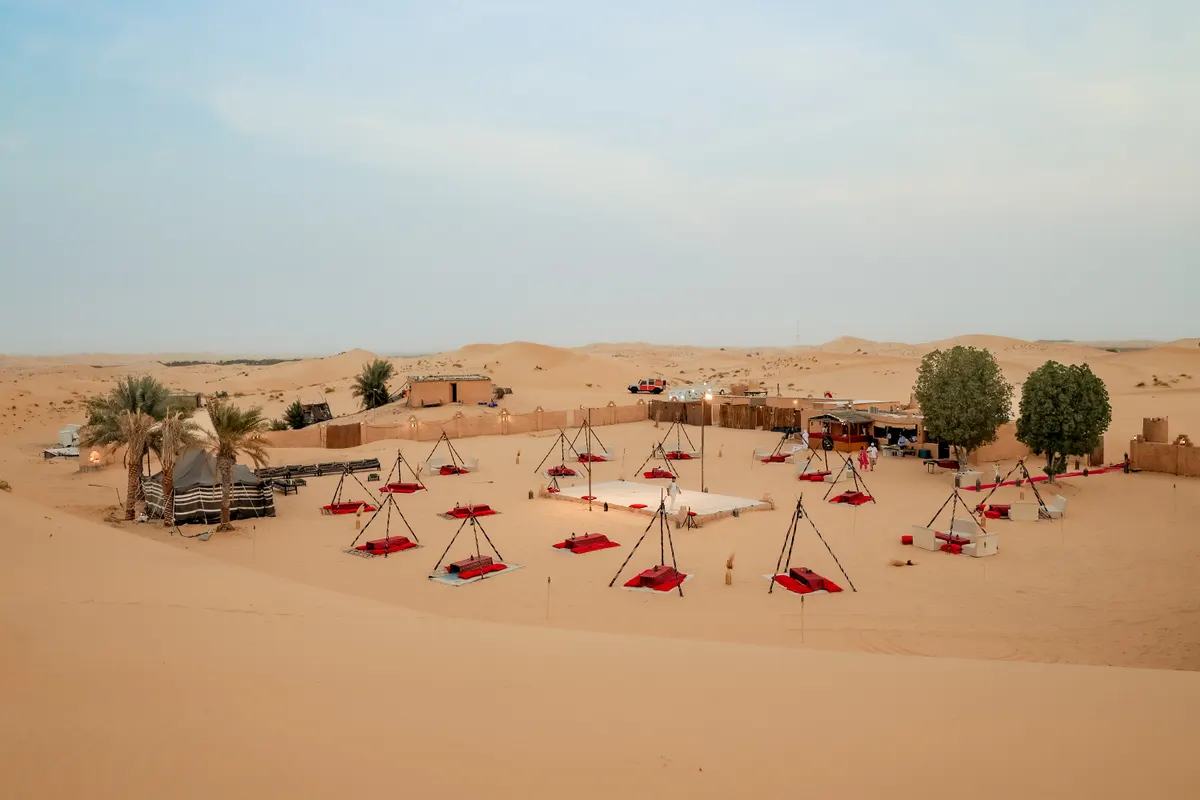
Desert camping in the UAE means very different things under one name. You can join a shared overnight camp run by a tour operator, take your own tent into the dunes, book a furnished tent on a shared glamping site, or take a private camp for your group alone. They differ in privacy, comfort, risk and price far more than in how they are described, so the useful question is not which is best but which matches what you want from the night. This guide sets out ten ways to camp, the rules that apply, the season, and what to ask before you pay.
We run a private desert camp ourselves, so we are not a neutral party here. But we have watched enough guests arrive disappointed because they booked the wrong tier for what they wanted that it is worth laying the whole spectrum out plainly, starting from the cheapest and working up.
The short version
- Desert camping in the UAE covers a shared tourist camp, a self-organised trip, shared or private glamping and a private buyout. They are priced and run nothing alike.
- Dubai Municipality has said a short weekend trip needs no prior permission; long-term or seasonal camping needs municipal permission and a fee. Rules differ by emirate, so check before you pitch.
- The comfortable camping season runs from late October to April. In summer, choose air-conditioned tents or an evening instead of an overnight.
- Whatever you book, ask for the all-in price, what the tent has (a real bed, a private bathroom, air conditioning that runs all night) and who else will be on site.
- Our own overnight stays at Khayal Al Sahra are published: from AED 3,200 to 5,500 a night for a couple's en-suite tent.
Which kind of desert camping fits you?
| Type | What you get | Best for | Ask before you book |
|---|---|---|---|
| Shared overnight tourist camp | Dune drive, shared buffet, a show, a shared tent block | Solo travellers, a first taste of the desert | Is the tent block shared? When does the show end? |
| Wild or self-organised | Your own tent and vehicles | Experienced off-roaders | Is the area allowed? Two vehicles, recovery kit, water. |
| Shared glamping site | Furnished tents booked separately by different guests | Couples and small groups | Photos of the actual tent; running water; who else is on site. |
| Private family or small-group overnight | A small private setup for one party, with a fixed menu | Families and friend groups | What the menu is; bathroom arrangements; the end time. |
| Resort-style desert stay | A hotel or resort with a desert setting | Guests who want hotel service | Rates by season; meals included; whether it hosts events. |
| Private buyout camp | The whole camp for one booking | Proposals, milestone birthdays, weddings, offsites | What is included; one booking a day? |
| Remote multi-day stay (Liwa) | Bigger dunes and darker skies, further out | Photographers, honeymooners | Transfer time; how far everything travels. |
1. The shared overnight tourist camp
The entry point for most first-time visitors. A tour operator runs dune bashing at sunset, drops you at a fixed camp site alongside several other unrelated groups, feeds everyone from a shared buffet, puts on a tanoura or belly dance show, and either drives you home or has you sleeping in a shared tent block.
It is inexpensive, it is easy to book same-week, and for a solo traveller or backpacker wanting a taste of the desert it does the job. The trade-offs are real: no privacy, a fixed schedule you do not control, and facilities shared with strangers.
2. Budget wild camping
Bring your own tent, drive out to open desert where camping is tolerated, and set up yourself. This is the cheapest option by far, essentially the cost of fuel and gear, and for experienced off-roaders it is genuinely rewarding.
It is also the option with the most real risk. You need at least two vehicles, recovery equipment, far more water than seems necessary, and someone who has driven soft sand before. Mobile signal disappears in dune fields. This is not a beginner's route into desert camping.
3. A shared glamping site
The next tier up from the tourist safari: a fixed site with several furnished tents, each booked separately by different guests or families, run by an operator who handles setup, food and washrooms. You get a real bed and proper facilities rather than a bedroll on the floor, but you are still one of several bookings on site that night.
This is where the word "glamping" starts doing a lot of marketing work. Ask for photographs of the actual tent you would be in, not the marketing set, and ask whether washrooms have running water.
4. A private family or small group overnight
Some operators, us included, will build a small private setup for a single family or friend group rather than mixing you with strangers. You still get a fixed menu and a simpler build than a full private camp, but the site is yours for the night. This suits a family wanting the desert experience without sharing it, at a more accessible price point than a full private buyout.
5. Desert glamping with genuine climate control
Above the basic glamping tier sits a smaller group of operators offering air-conditioned or properly insulated tents, which matters more than people expect. A generator that gets switched off overnight for noise turns a summer night into a genuinely uncomfortable one. If climate control is advertised, ask directly whether it runs all night.
6. A stargazing-focused overnight
A specific niche worth calling out on its own: camps built or timed around dark skies, usually scheduling around the new moon and cutting camp lighting for a window after dinner. If astrophotography or genuinely seeing the Milky Way is the point of your trip, ask any operator about their moon-phase planning specifically, most do not think about it at all.
7. A multi-day desert stay
Two or three nights rather than one, usually at a site further from the city where the extra travel time is worth it once you are there, such as Liwa at the edge of the Empty Quarter. This suits photographers, honeymooners and anyone who wants a full day in the desert between arrival and departure rather than a single evening either side of a long drive.
8. A private buyout desert camp
This is where we sit. A private buyout means the whole camp, the site, the timeline, the crew and the menu belong to one booking, not a shared site with your section of it. Nobody else's group is walking through your photographs or competing for the fire pit.
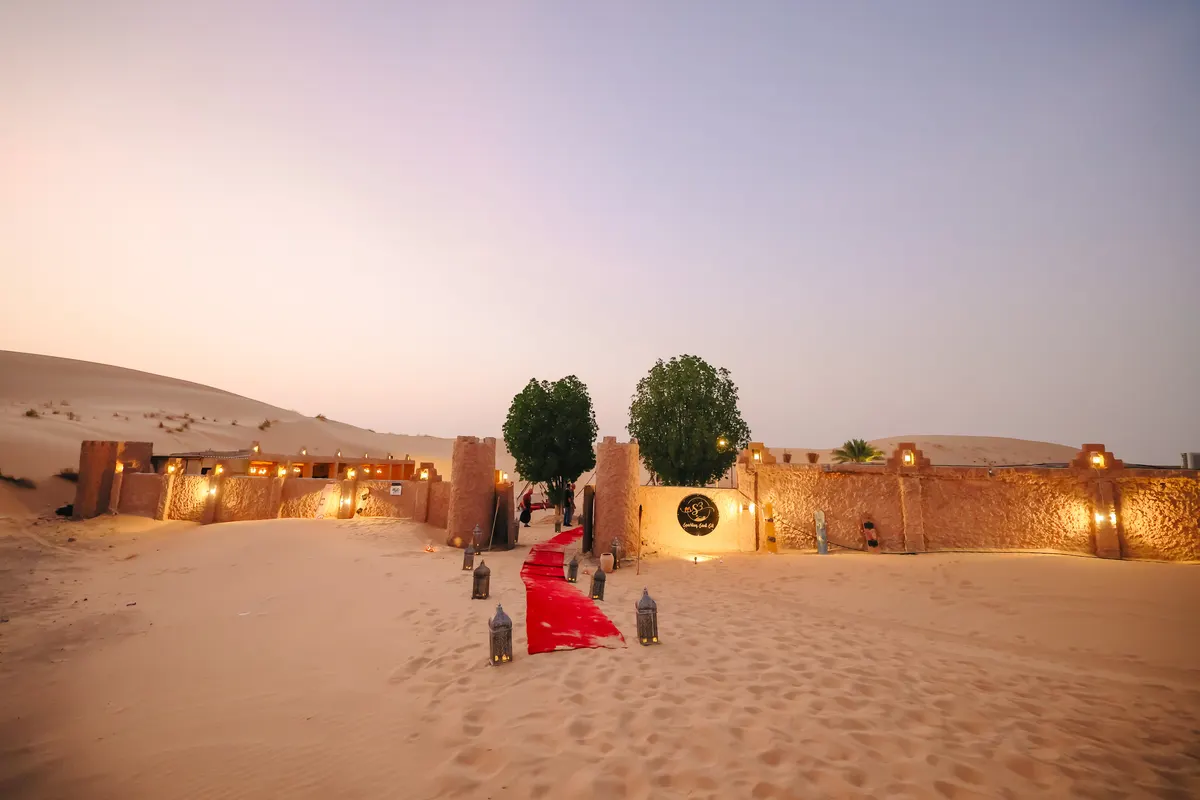
At Sparkling Sandset, our camp Khayal Al Sahra at Al Khatim takes a single booking a day. We have run it since 2012, delivered over 500 events, and roughly 85% of our corporate clients return, which we think says more than any description of the tents does. It is priced above a shared site because the whole build is dedicated to you rather than divided across several bookings, and it suits a proposal, a milestone birthday, a wedding night or a small corporate group that wants privacy as part of the experience rather than an afterthought.
If this level of privacy is the point, our private glamping and overnight stays page has the detail on what a buyout actually includes.
9. A themed or occasion-built private camp
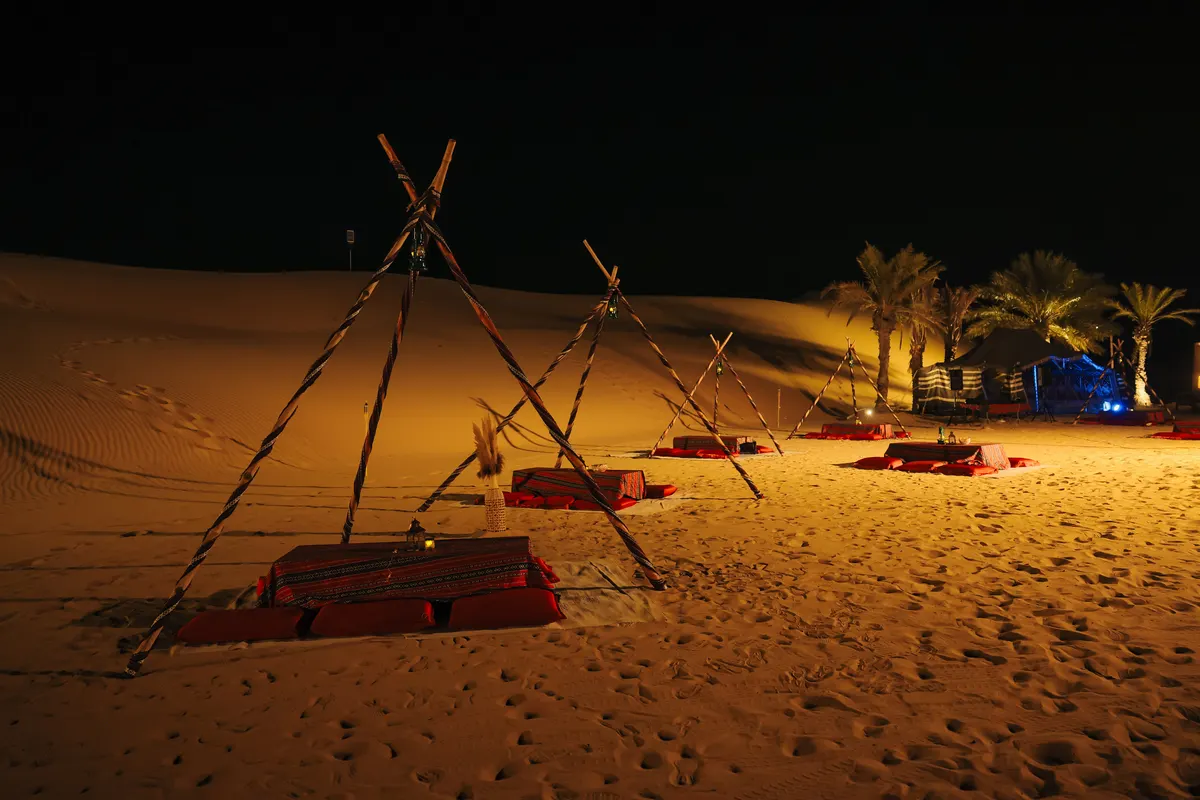
One step further: a private camp designed around a specific occasion, a proposal setup with a particular sightline, a birthday with cultural entertainment built around the honoree, a corporate offsite with a facilitated session before dinner. This is bespoke production rather than a package, and pricing is quoted per booking because most of the cost is the build, not the headcount. For a look at what a properly built overnight involves once the sun is down, our guide to what the desert night is actually like covers the part most people never plan for.
10. Liwa: the private overnight at the top of the scale
The rarest and most expensive tier: a private multi-day build at Liwa, two and a half to three hours from Abu Dhabi at the edge of the Empty Quarter, where the dunes run over 300 metres and the night sky has no city glow within a hundred kilometres for the entire stretch. Everything travels three hours to get there, which is why it costs more than an Al Khatim build, but for guests who have already done the closer desert and want scale, it is a different order of experience. Our complete guide to Liwa desert camping covers getting there, when to go and what it actually costs.
The rules: can you camp anywhere in the UAE desert?
No, and the rules differ by emirate and change from season to season, so treat this as a map rather than legal advice and check with the municipality for the area you plan to use. What UAE media reported, with the date of the most recent update:
- Short stays. Dubai Municipality has said that for a short weekend trip you do not need prior permission to pitch a tent in the desert. Long-term or seasonal camping needs permission from the local municipal authority and a fee, which varies by emirate and duration (Gulf News, October 2025).
- Allowed areas. Camp only where the authorities allow it. Popular spots named in the press include Al Qudra Lakes, Lahbab Desert and Al Aweer Desert near Dubai and Al Wathba Lake Camp in Abu Dhabi, but each location can carry its own restrictions or permit requirements. In Abu Dhabi, check with the Department of Municipalities and Transport or the regional municipality before camping outside a licensed site.
- Waste. Dumping, burning or burying waste outside designated areas is illegal under Federal Law No. 12 of 2018, with fines of up to AED 30,000 for individuals. Take everything out with you.
- Wildlife and vegetation. Federal Law No. 24 of 1999 prohibits damaging natural reserves, including cutting trees and disturbing wildlife. Environment Agency Abu Dhabi asks visitors to stick to established routes, keep speeds low, avoid driving over vegetation or through water pools, never feed wildlife and leave no debris.
- Wadis and flood zones. Keep out of valleys and wadis when rain is forecast. Entering a valley or flood zone during rain carries a AED 2,000 fine, 23 traffic points and 60 days' vehicle impoundment under Federal Decree-Law No. 14 of 2024.
- Sharjah and Fujairah. Pitching tents in unauthorised areas or leaving litter can bring fines of up to AED 2,000 under local rules.
A licensed, serviced camp takes most of this off your hands: the site, the permits and the waste handling are the operator's job, which is a large part of what you pay for.
When to go
The winter camping season is generally described as running from late October to April, when days are mild and nights are cool. Winter-camp permit windows for 2026-27 are being announced emirate by emirate this month; Umm Al Quwain's applications opened on 19 October. In summer, an ordinary tent is not sensible, and the right choices are an air-conditioned tent that runs all night or an evening in the desert instead of an overnight. Our UAE weather by month guide shows what each month feels like, and our camping in the UAE guide collects the practical points in one place.
Safety and what to bring
- Fire. Keep lanterns and light sources at least 50 cm from tents, never use a barbecue or coal burner inside a tent, keep a fire extinguisher nearby and store firewood well away from tents.
- Driving. If you drive into the dunes yourself, travel with at least two vehicles, carry recovery equipment and expect mobile signal to disappear.
- Water and layers. Take far more water than seems necessary, sun protection and warm layers, because winter nights in the desert are cold after a warm day.
- Leave no trace. Bring bags for every scrap of rubbish and carry it out.
Hotels and resorts in the dunes
If you want a desert setting with a hotel's service, several resort-style properties sit in or beside the dunes. A May 2026 Wego guide to glamping in the UAE names Qasr Al Sarab, a palace-style resort at Liwa on the northern edge of the Empty Quarter; Al Badayer Retreat, with 25 private tents in the central Sharjah desert; Anantara Al Sahel on Sir Bani Yas Island, with 30 tented pool villas; Hatta Domes in the Hajar Mountains; and Longbeach Campground on the beach in Ras Al Khaimah. These are primarily stays for guests, and rates move with the season, so check each operator for current prices. If your plan is a private occasion for a group, with the camp reserved for you alone, that is the other product, and it is ours.
What our overnight stays cost
We publish our overnight bands rather than hide them. Per night at Khayal Al Sahra, a couple's en-suite tent is AED 3,200 to 5,500; a family tent for three to five guests is AED 6,000 to 9,500; group glamping for 10 to 30 guests is AED 28,000 to 65,000; and a full camp buyout for 30 to 80 guests is AED 75,000 to 160,000. Each stay includes the en-suite tents, dinner and a cooked breakfast, and the full list is on our overnight stays page. Other operators price differently, which is why the all-in figure and what it includes matter more than the headline number.
How to actually choose
- One evening, tight budget, first time in the desert: a shared tourist camp does the job.
- Comfortable overnight without breaking the bank: a shared glamping site, with the four questions above asked upfront.
- Family trip, want your own space: a private family overnight.
- Proposal, anniversary, milestone birthday: a private buyout camp.
- Corporate offsite or incentive group: a private camp with a facilitated element built in.
- You want the biggest dunes and darkest sky in the country: Liwa, ideally overnight rather than a day trip.
None of these is the "correct" way to camp in the desert. They are different products at different prices, and the mistake is booking one tier while expecting the experience of another. If you want to see what the private end of that spectrum actually looks like, our guide to what to expect from glamping in Abu Dhabi and our page on desert glamping in the UAE both go into the detail that separates a genuine private camp from a shared site marketed to look like one.
FAQs
Can you camp anywhere in the UAE desert?
Not freely. Dubai Municipality has said a short weekend trip needs no prior permission to pitch a tent, but long-term or seasonal camping needs municipal permission and a fee, and rules differ by emirate. Camp only in areas the authorities allow, stay out of wadis and flood zones, and take every scrap of rubbish with you.
Do you need a permit to camp in the UAE desert?
For a short weekend stay in Dubai, no, according to Dubai Municipality as reported by Gulf News. For long-term or seasonal camps you need permission from the local municipality and must pay a fee, which varies by emirate and duration. Check the current rules for the area you plan to use before you go.
When is the desert camping season in the UAE?
The winter camping season generally runs from late October to April, when days are mild and nights are cool. In summer, daytime temperatures are extreme, so choose an air-conditioned tent that runs all night or an evening in the desert rather than an overnight.
Where can you go desert camping near Dubai and Abu Dhabi?
UAE media name Al Qudra Lakes, Lahbab Desert and Al Aweer Desert near Dubai and Al Wathba Lake Camp in Abu Dhabi as popular spots, though each area can carry its own restrictions. For a serviced private camp, Khayal Al Sahra at Al Khatim is about 50 minutes from Abu Dhabi city and 90 minutes from Dubai.
How much does desert camping cost in the UAE?
There is no single figure, because the options differ so much. Wild camping costs fuel and gear, shared camps and glamping sites usually charge per person, and private camps charge per night or per booking. For reference, our own overnight bands run from AED 3,200 to 5,500 for a couple's en-suite tent up to AED 75,000 to 160,000 for a full camp buyout. Ask any operator for an all-in figure.
Is desert camping safe in the UAE?
With preparation, yes. Camp in permitted areas, avoid wadis and flood-prone ground, keep lanterns at least 50 cm from tents, never use a barbecue or coal burner inside a tent, carry plenty of water and travel with at least two vehicles if you drive into the dunes. A serviced camp handles the safety planning for you.
Can you go desert camping in the UAE in summer?
It is not sensible in an ordinary tent. For a summer night in the desert, choose a camp with air-conditioned tents that run all night, and ask the operator directly whether the cooling is on for the whole night. Otherwise, take an evening in the desert instead of an overnight.
What should I bring for desert camping in the UAE?
Warm layers for the night, sun protection, closed shoes, plenty of water, a torch, chargers and bags for your rubbish. Serviced camps supply bedding and meals, so you bring much less than for wild camping.
What is the cheapest way to go desert camping in the UAE?
Wild camping with your own gear costs the least, essentially fuel and equipment, but it needs proper off-road experience and at least two vehicles for safety. For a serviced option without that risk, a shared overnight tourist camp is usually the most affordable, though prices vary by operator and season, so ask for an all-in figure per person.
What is the difference between a desert safari and desert glamping?
A desert safari is typically an evening tour, dune bashing, dinner and a show, home by around 10pm. Glamping means staying overnight in a furnished tent with a real bed, which is where most people find the desert actually gets interesting, once the day-trippers have gone and the sky comes out.
Is a private desert camp worth the extra cost over a shared site?
It depends what you are booking for. For a quick taste of the desert, a shared site is perfectly reasonable. For an occasion where privacy is part of the point, such as a proposal, a wedding night or a leadership offsite, a private buyout removes the variables a shared site cannot control, other groups, a fixed shared schedule and photographs with strangers in them.
Do I need a 4x4 to go desert camping in the UAE?
Only if you are driving yourself into the dunes for wild camping. Serviced camps, whether shared or private, handle transport as part of the booking, so a standard vehicle to a pickup point or a paved access road is usually all that is needed.
Sources
- Gulf News: UAE camping rules explained: permits, fines and safety guidelines (updated 31 October 2025)
- Gulf News: Guide: do I need a permit to camp in the UAE? (updated 6 December 2024)
- Gulf News: Protect the desert during trips and safaris, Environment Agency Abu Dhabi urges (updated 30 January 2022)
- Wego: Glamping in the UAE, five unexpected luxury camping escapes (29 May 2026)
- Emirates 24|7: Umm Al Quwain winter camping permits 2026-27, applications open 19 to 30 October
Related guides

Tabassum founded Sparkling Sandset in 2012 and has run the Al Khatim camp through more than 500 private weddings, celebrations and cultural events since. She writes about the celebration and hospitality side of the business: weddings, birthdays, cultural programming and what it actually takes to host a private desert night well.